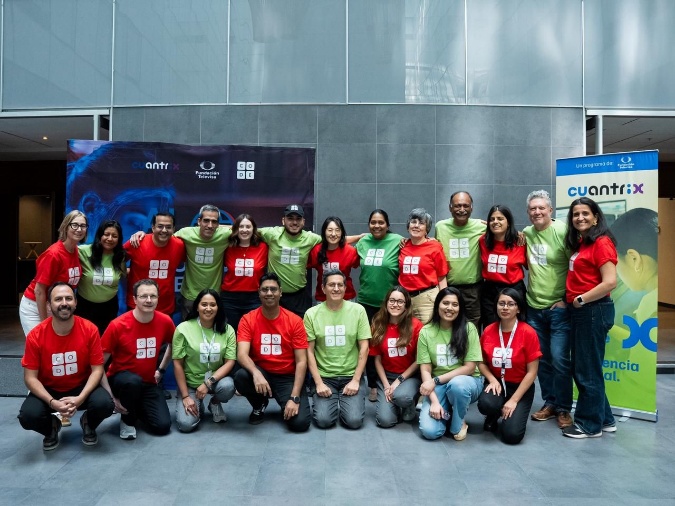
Asha Chennai was invited by Code.org to their Global Partner Meeting (AIEDU Global Meeting) held in Mexico. Mr. Venkat, Asha Volunteer attended the meeting and here is his report.
Code.Org Partner Meeting at Mexico
By Mr. Venkat Ramasamy- Volunteer, Asha Chennai
Code.org organized a Global Partner Meeting (AIEDU Global Meeting) held in Mexico from October 27–29, 2025.
The summit served as a pivotal moment for international partners to align on the “AI + CS” (Artificial Intelligence and Computer Science) transition, ensuring that the shift toward AI education remains inclusive and human-centered.
1. Executive Summary
The meeting focused on the “AI for Education” (AIEDU) framework, emphasizing that Computer Science education must now evolve to include AI literacy as a fundamental right. Partners from India, Chile, Spain, Uruguay, and Mexico shared localized strategies for integrating Generative AI into classrooms while maintai
ning a focus on foundational literacy and equity.
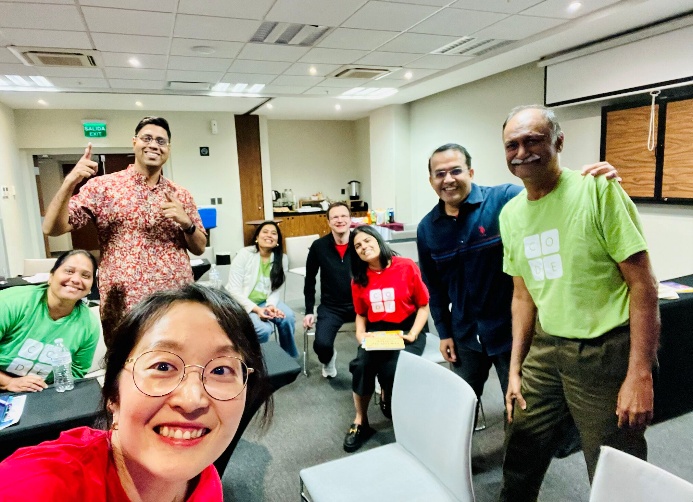
- India: Asha for Education (Asha Chennai), Central Square Foundation (CSF), Leadership for Equity (LFE).
- Mexico: Fundación Televisa (Cuantrix, Tecnolochicas).
- Chile: Fundación Kodea.
- Spain: Generación Code.
- Uruguay: Ceibal.
2. Agenda
Oct 26 – Pre-meeting Dinner
Oct 27 – Welcome presentations by Hadi Partovi, Forest Key and Alejandro Villanueva
Oct 27 – Code.Org presentation about Shaping AI Education
Oct 27 – Art Museum (not open to the public) – Opportunity to view artifacts preserved by Fundación Televisa
Oct 27 – Partner Presentations – what each partner is doing in their domain
Oct 27 – Optional event to go into town
Oct 28 – 2 School visits in the Mazahua Region
Oct 28 – Visit a Tecnolochica school in Toluca
Oct 28 – Lucha Libre – Fun evening at a wrestling event
Oct 29 – Code.Org presentations on Impact of CS Education, AI Framework, etc.
Oct 29 – Split Spanish speaking groups and Indian groups for partner presentations
3. School Visits
On October 28th all the partners were transported by bus to the Mazahua region. It took about two hours by bus. We first went to a middle/high school. The students welcomed all the visitors with garlands. They must’ve run out of flowers, so some of the garlands were made of cookies and bread.
The first school we visited was a combination middle school and high school. All of the students were bilingual, speaking Spanish and Mazahuan. They had a large playground, basketball backboards, very rural almost like Asha supported schools. There was a trainer who was training the teacher in the school who was helping these students. The school had a computer lab with about 20 computers much like our hi-tech labs in our high schools. They were learning to program in scratch and all of the students completed their exercise which was impressive. They all had access to a computer, so they worked independently.
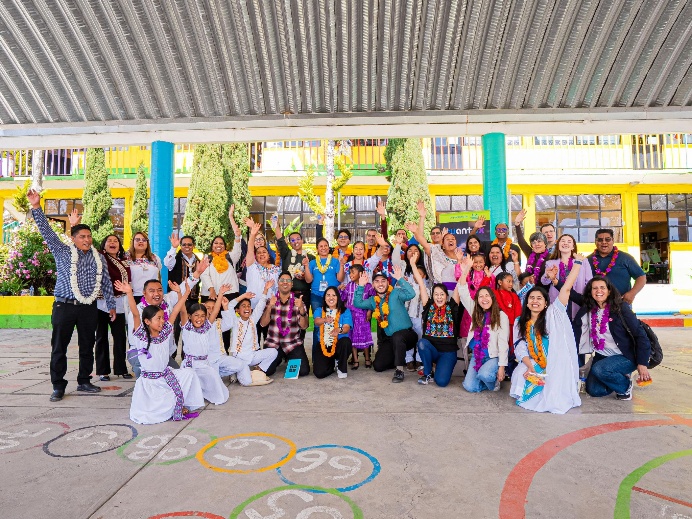
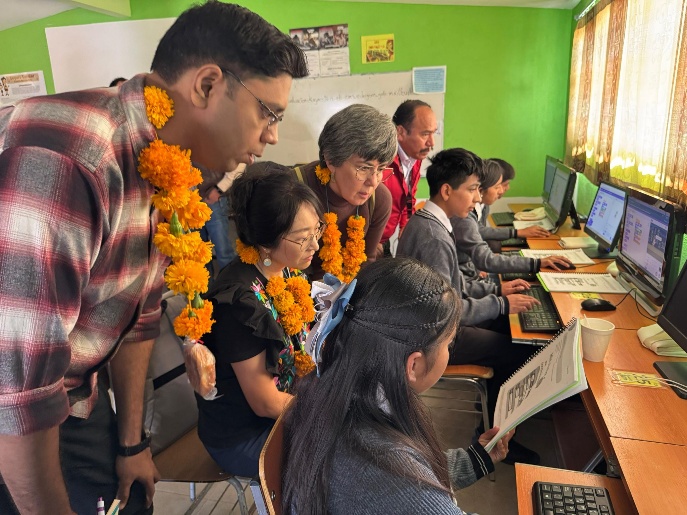
The next school was an elementary school. They also had a large playground and basketball backboards. It was interesting that the whole area was free of garbage unlike these locations in India. Most of the children at both schools were dressed in traditional Mazahuan clothes and apparently they come to school everyday in those clothes. They only had one computer and everyone who spoke including the teachers and students were pitching for additional funds for more computers. The children were really eloquent and had no stage fright when speaking. It was interesting to see that they didn’t have running water in the school and the children had to carry a bucket with water when going to the restroom.
We traveled from there to a city called Toluca where the high school was well funded and associated with the local University. The school was supported by Tecnolochicas (another arm of Fundación Televisa. This was a far more advanced school. The teacher and students were performing at a pretty advanced level compared to our high school students. They were learning to simulate a breadboard and insert resistors and LEDs appropriately. The school itself had a very small playground and was overflowing with students.
4. Key Themes
A. The “AI + CS” Curriculum Shift
A major consensus was reached on evolving the standard coding curriculum. The group discussed how tools like “AI Buddy” and the “Hour of AI” are being used to move beyond syntax-heavy coding toward prompt engineering, algorithmic bias awareness, and ethical AI usage.
B. Teacher Empowerment and Capacity Building
- Scaling Training: The challenge of training millions of teachers was a central theme.
- Co-Pilot Models: Partners explored “AI-assisted teaching,” where teachers use AI to generate lesson plans and provide personalized feedback to students, reducing administrative burdens.
C. Digital Governance and Public Policy
Ceibal (Uruguay) and Kodea (Chile) and other partners discussed how to work with ministries of education to create national frameworks. Almost all the institutions represented were closely working with the government in some way including CSF and LFE from India. The goal seems to be to move from “pilot projects” to “systemic policy” that mandates AI literacy in the public school system.
5. Regional Contributions and Insights
| Organization | Key Focus Area / Contribution |
| Asha for Education | Rural Access: Scaling digital literacy in under-resourced schools in India; shared data on “offline-first” AI tools for rural contexts. |
| Central Square Foundation | Foundational Literacy: Integrating CS with the NIPUN Bharat mission; focusing on how EdTech supports basic numeracy and literacy. They are also working IITM to create a national strategy for AI education. |
| Leadership for Equity | Systems Change: Shared models for working within government administrative structures to ensure CS policies reach the “last mile.” |
| Fundación Kodea | The Digital Divide: Presented the “Los Creadores” initiative; emphasized bridging the gender gap in STEM across Chile and LATAM. They use a platform to create quality assessments that are also graded by the system. This is something Asha has a keen interest in using. They also work with a University in Chile to create a white paper about the impact they are having in Chile. |
| Ceibal | Digital Sovereignty: Shared Uruguay’s model of providing universal device access and the governance needed to manage data privacy in AI education. They are working towards getting one device per student. Obviously Uruguay is one of the wealthiest countries in the region and can afford it. |
| Fundación Televisa | Bilingual & Scaled Impact: Highlighted the Cuantrix program’s success in training 31,000+ Mexican teachers and the Tecnolochicas expansion. |
| Generación Code | European Standards: Discussed aligning AI curriculum with European digital competency frameworks (DigComp). |
6. Learnings
- All the partners at the meeting were deeply connected with their respective governments and were formulating and proposing policies. Code.org themselves are looking to impact policies around the world to make CS and AI education more accessible to children in all walks of life.
- None of the other partners seem to employ their own teachers. They are either creating curriculum or working with government teachers. As such their knowledge of ground realities with the exception of Cuantrix in Mexico, is slightly less than us at Asha Chennai.
- Everyone has made a fundamental shift from Coding to Artificial Intelligence. Their presentations seemed to suggest that they have figured how to teach AI, but individual conversations threw light on their struggles as well, although they have thought about this a lot longer than Asha and are ahead in terms of AI literacy.
- I also learnt from these organizations that their funding was becoming more and more tied to AI education rather than CS education much like Asha Chennai’s experience with Amazon.
- Code.org has close to 130 activities available for their partners to use. The collection includes submissions from many different organizations including universities, corporations and organizations like Khan Academy.
7. Asha for Education Chennai – AI Integration
There are potentially things that Asha can do in steps as we move forward to integrate AI into our curriculum.
Phase I: Curriculum Localization & Adaptation
- AI-Enhanced Kanini Platform: Update the Kanini software to include “Offline AI” modules. These modules will use lightweight, locally hosted Large Language Models (LLMs) that do not require high-speed internet.
- Bilingual Content: Translate Code.org’s “Hour of AI” resources into Tamil and Hindi, ensuring the vocabulary is culturally relevant for rural students.
Phase II: Teacher Capacity Building
- AI Teacher Support Agents: Inspired by the Mexican Cuantrix model, Asha can pilot AI-powered chatbots to assist both Asha teachers and government teachers in troubleshooting coding errors and create efficient code especially when we move to text based coding.
- RTC Training: We could ask motivated Asha teachers to take classes at our RTCs as well.
Phase III: Policy Alignment & Scaling
SCERT Partnership: Work with SCERT to address issues with TN Spark
- Data-Driven Advocacy: Use the assessment data from Kanini to provide evidence to the Ministry of Education on the effectiveness of AI-assisted learning in rural contexts.
- Modify TN Spark curriculum to include Projects at the end of each year.
- Provide a model for training government teachers effectively
- Make working with the government and NSNOP a priority
This video provides a visual overview of the discussions and key attendees from the AIEDU meeting in Mexico, including the organizations mentioned in this report.